Activated Charcoal Adsorption of PFAS in Bile Secretion Model
Per- and Polyfluorinated Substances [PFAS] are an invasive global pollutant which is well documented to accumulate in people and animals with various serious health risks. It is estimated there are 10,000 to 15,000 unique compounds. Here is a short-list of 8,163 on the EPA website. Their breakdown and elimination from the body can stretch into 5+ years. PFAS exposure is linked to reduced immune response, reproductive issues, developmental delays in children, elevated cholesterol, thyroid disorders, and increased risks of certain cancers. Can the oral use of Activated Charcoal lower the concentration of these “Forever Chemicals” in the human body? Very recent research conducted by collaborating medical universities in Italy strongly suggests it can.
Vegetable Activated Charcoal for Human Consumption Reduces Selected PFAS Levels in a Bile Secretion Model: Cues on Its Possible Clinical Use
- Alessandro Bonetto
- Luca De Toni
- Andrea Di Nisio
- Laura Pagnin
- Alberto Ferlin
- Antonio Marcomini*
- Carlo Foresta
Published in Chemical Research in Toxicology Vol 39/Issue 5 May 5, 2026
Copyright © 2026 The Authors. Published by American Chemical Society
Abstract
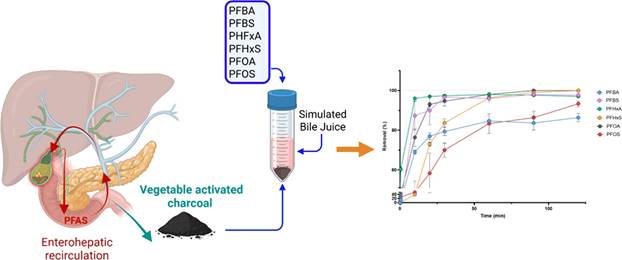
….A significant increase in fecal excretion has been experimentally assessed with the use of oral adsorbents with negligible gut absorption. Here, we evaluated in vitro the use of activated charcoal (AC) for human consumption, as sorption material for a panel of PFAS, such as, perfluoro-butanoic acid (PFBA), perfluoro-butanesulfonic acid (PFBS), perfluoro-hexanoic acid (PFHxA), perfluoro-hexanesulfonic acid (PFHxS), perfluoro-octanoic acid (PFOA), and perfluoro-octanesulfonic acid (PFOS), in an experimental simulated bile juice (SBJ). The aim was to obtain preliminary data for possible clinical applications to reduce PFAS blood levels in humans… All PFAS showed more than 80% sorption on activated charcoal from simulated bile juice within 120 min. This suggests rapid and nearly complete removal… These data are suggestive of a potential noninvasive intervention strategy to increase fecal PFAS excretion through the dietary use of AC, in order to mitigate health issues associated with PFAS exposure.
Here is a simple graphic showing the potential use of food grade coconut shell activated charcoal in aiding the removal of certain common PFAS by binding them, thus disrupting their enterohepatic recirculation, and eliminating them in the feces.
Source: ACS Publications
Figure 1. Experimental evaluation of the time-dependent removal of a panel of perfluoroalkyl substances from a simulated bile juice by activated charcoal for human consumption. Data are reported as the mean value ± standard deviation of a technical replicate. Abbreviations: PFBA, perfluoro-butanoic acid; PFBS, perfluoro-butanesulfonic acid; PHFxA perfluoro-hexanoic acid; PFHxS, perfluoro-hexanesulfonic acid; PFOA, perfluoro-octanoic acid; PFOS, perfluoro-octanesulfonic acid.
The reported technical data of food grade coconut shell-based Activated Charcoal were as follows: average grain size of 15–35 μm, with 90% less than 74 μm, iodine number of approximately 1000 mg/g, and average surface area of 1800 m2/g. This grade compares closely with USP Coconut Activated Charcoal Powder – Detox and Cleanse
Dosage equivalents
The experimental estimated daily oral dose of AC was 7 g/day, divided into two single doses of 3.5 g each, to be taken away from meals.
3.5 g approximates 1 teaspoon of AC powder or 12 AC capsules.